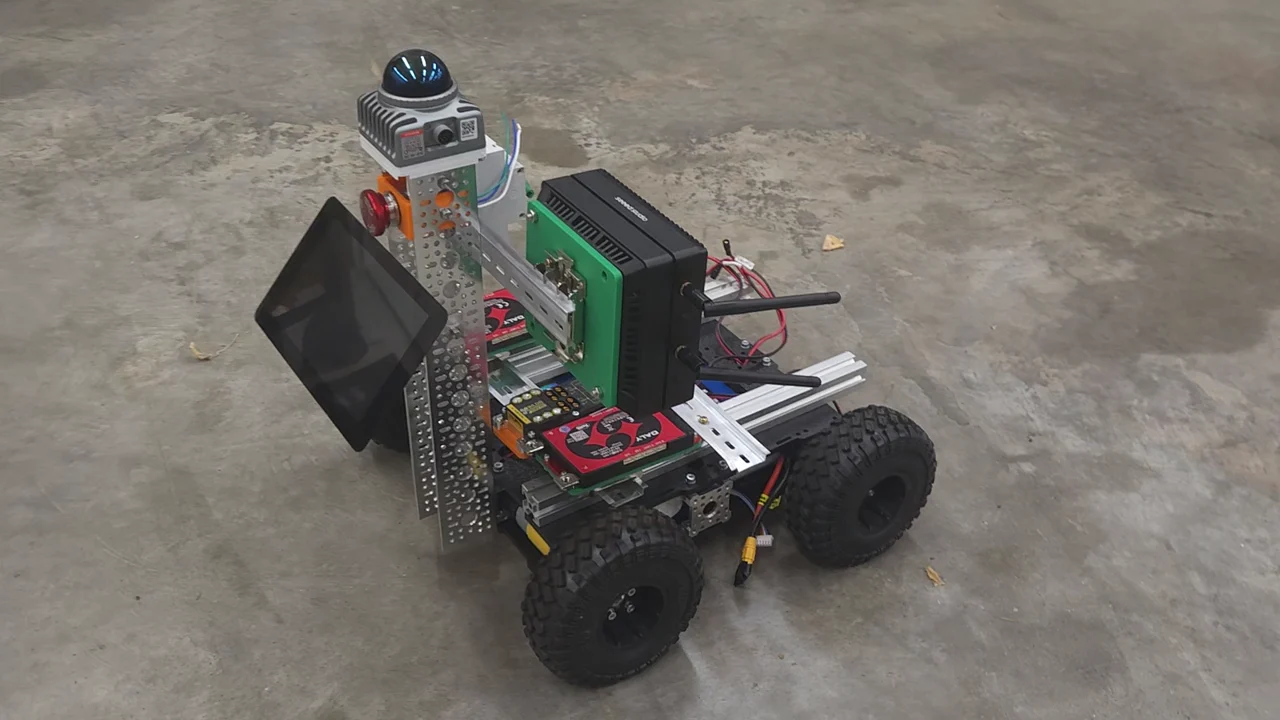
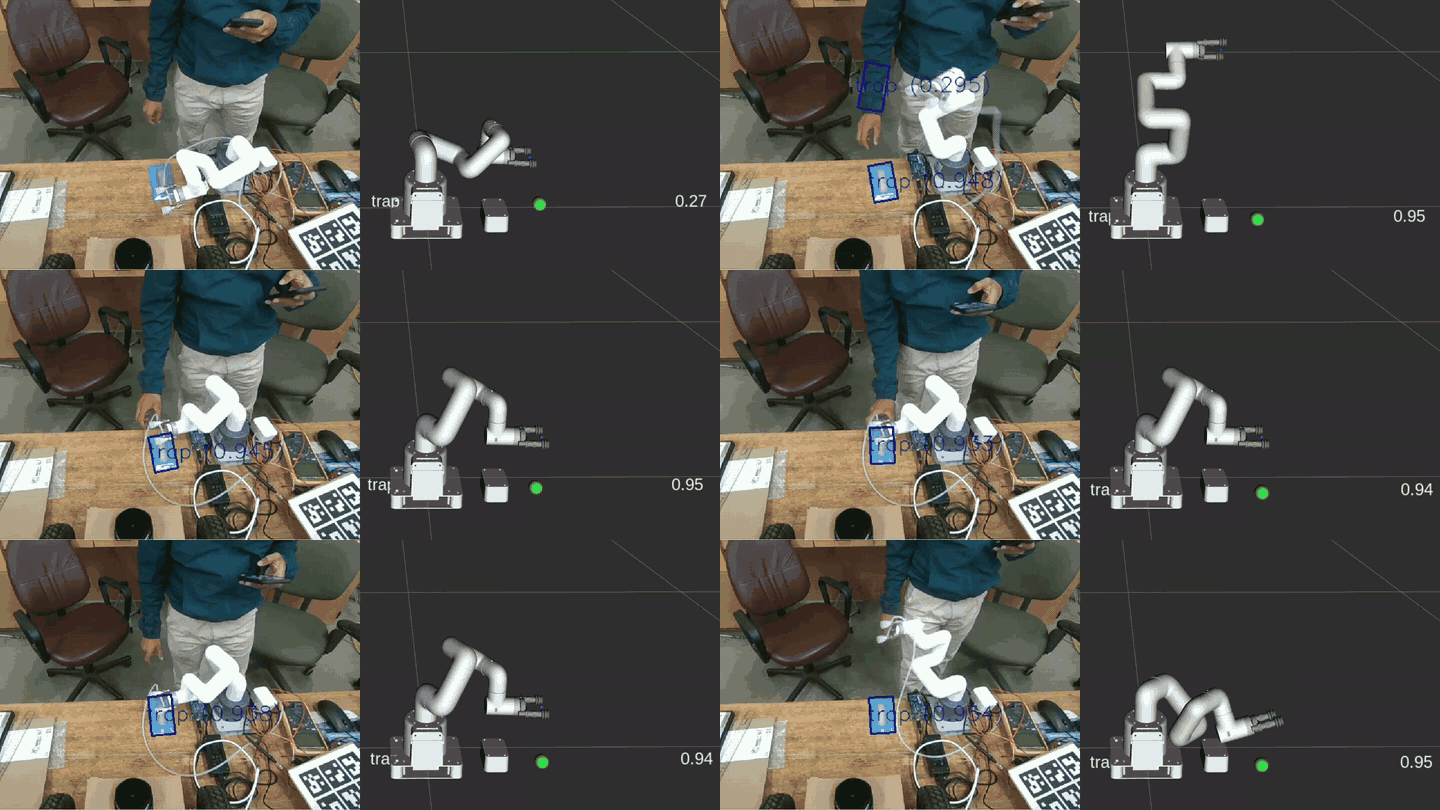
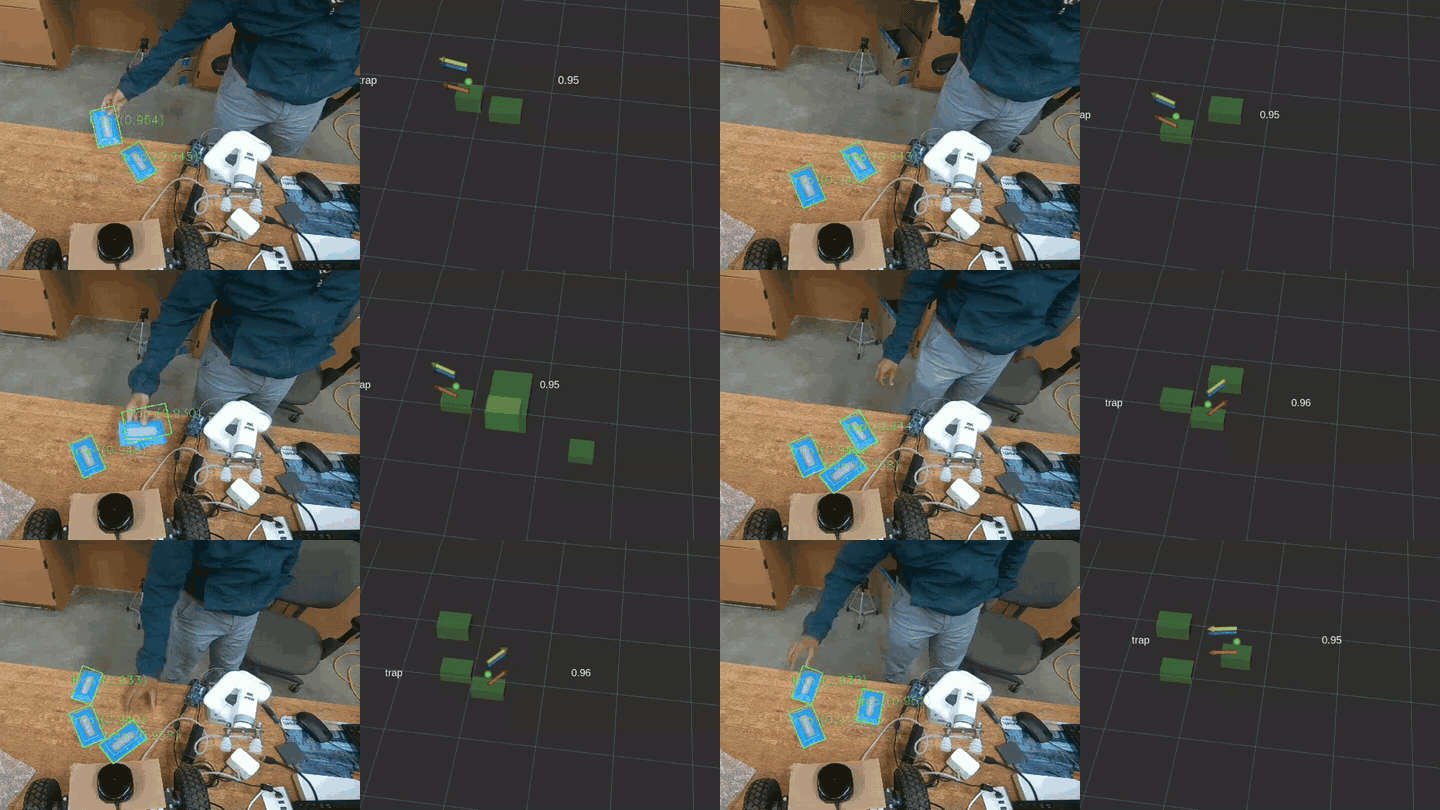
Lab demonstration of the MMPT mobile base.Front view of the built prototype.Rear view of the built prototype.
MY CONTRIBUTIONMobile platform integration, dataset development and perception
PLATFORMgoBILDA Recon · Jetson Orin NX · RealSense D455
CURRENT STAGEPhase I demonstrated; navigation and manipulation in progress
THE CHALLENGE
Make pest monitoring easier to service.
Insect traps in large food-storage structures need regular inspection and replacement. A mobile service robot could reduce repeated manual collection, particularly in hard-to-reach floor areas.
Conceptual architecture: the perception platform is demonstrated; navigation and autonomous manipulation are in development. Click to enlarge
ENGINEERING WORK
Integrating perception with a mobile platform.
Robot integration
Configured ROS 2 on the NVIDIA Jetson Orin NX, the onboard computer for the goBILDA Recon base.
Installed ROS packages in an isolated Docker environment.
Connected wirelessly to the Jetson using SSH over Tailscale.
ROS 2Jetson Orin NXgoBILDA ReconDockerSSHTailscale
Data and perception
Curated and annotated 584 trap images in CVAT.
Trained YOLOv8n-OBB to estimate each trap’s position and orientation.
Ran the detector in ROS 2 using YOLO-ROS and images from the Intel RealSense D455.
CVATYOLOv8n-OBBYOLO-ROSRealSense D455
Navigation and manipulation
Use Nav2 to navigate the mobile base, MoveIt to plan arm motion, and ros2_control to control the hardware.
Camera-to-arm calibration and integration of the 6-DOF arm with its suction end-effector are in progress.
Planned: Use FastLIO for LiDAR-inertial odometry so Nav2 can track how far the robot moves and turns.
Nav2MoveItros2_control
MODEL DEVELOPMENT
Detection with orientation.
Oriented bounding boxes represent a trap’s position and angle, providing information needed for future grasp alignment. Dataset split: 410 training, 117 validation and 57 test images.
Trap detection performance at the best and final training checkpoints.
Metric
Best · epoch 144
Final · epoch 184
Precision
0.955
0.941
Recall
0.991
1.000
mAP50
0.992
0.989
mAP50–95
0.950
0.938
We conducted this research at the University of Tennessee, Knoxville, with the USDA-ARS Center for Grain and Animal Health Research. USDA-NIFA supported the project through CPPM award 2024-70006-42874.
 Rajesh Gund